PDF Download The Way of the World (New York Review Books Classics), by Nicolas Bouvier

PDF Download The Way of the World (New York Review Books Classics), by Nicolas Bouvier
Reading a publication can assist you to improve your idea, minds, lesson, experiences, as well as fun. Even you have read many type of book; it will give both same and different influences. For this book, you can find a new means related to just what you really require today. By investing just couple of times a day to read The Way Of The World (New York Review Books Classics), By Nicolas Bouvier, you future will be much better with the lesson to get now. Prepare and also always remind regarding it!
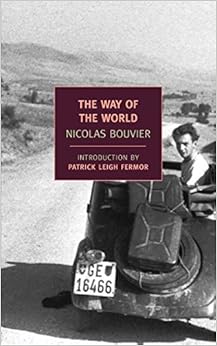
The Way of the World (New York Review Books Classics), by Nicolas Bouvier

PDF Download The Way of the World (New York Review Books Classics), by Nicolas Bouvier
Superb The Way Of The World (New York Review Books Classics), By Nicolas Bouvier book is consistently being the very best good friend for investing little time in your workplace, night time, bus, and also everywhere. It will be a great way to simply look, open, and also read the book The Way Of The World (New York Review Books Classics), By Nicolas Bouvier while in that time. As known, experience and also ability do not consistently come with the much cash to get them. Reading this publication with the title The Way Of The World (New York Review Books Classics), By Nicolas Bouvier will allow you know a lot more things.
Yeah, as the best seller book for around the world showed in this web site, The Way Of The World (New York Review Books Classics), By Nicolas Bouvier ends up being additionally a motivating soft data book that you could better read. This is a book that is composed by the popular writer on the planet. From this case, it's clear that this website doesn't just give you domestic publications however also the worldwide books.
One to be factor of why you have to pick this book can be obtained when you're beginning. In addition, when finishing this publication, you can really feel various life. What type of difference? It will also rely on your choice to change your life. Yet, in fact this The Way Of The World (New York Review Books Classics), By Nicolas Bouvier become some of the most wanted book worldwide. It offers you not only experience but additionally the brand-new understanding.
What kind of book The Way Of The World (New York Review Books Classics), By Nicolas Bouvier you will like to? Now, you will certainly not take the published publication. It is your time to obtain soft documents publication The Way Of The World (New York Review Books Classics), By Nicolas Bouvier instead the published records. You could enjoy this soft documents The Way Of The World (New York Review Books Classics), By Nicolas Bouvier in at any time you anticipate. Also it is in expected location as the various other do, you can review the book The Way Of The World (New York Review Books Classics), By Nicolas Bouvier in your device. Or if you desire a lot more, you can continue reading your computer system or laptop to obtain full display leading. Juts discover it here by downloading and install the soft data The Way Of The World (New York Review Books Classics), By Nicolas Bouvier in web link page.
Review
"A genuine masterpiece, an exhilarating, innocent, perceptive and wholly enjoyable young man's travel book, and a discovery of the Asian road that by rights deserves to occupy the same shelf as great classics of the genre such as Robert Byron's The Road to Oxiana or Eric Newby's Short Walk in the Hindu Kush." --The Financial TimesThe exhilaration of the open road and the feeling of connectedness to the natural world that it can produce, is, after all, a common human experience. Simply expressed, it has produced some of mankind’s greatest writing. The Swiss travel writer Nicolas Bouvier explores this territory in his youthful masterpiece, The Way of the World, where he conveys as well as anyone the raw intoxication of being on the road.” —The New York Times "The Way of the World is a masterpiece which elevates the mundane to the memorable and captures the thrill of two passionate and curious young men discovering both the world and themselves. Racy and meditative, romantic and realistic, the book is as brilliant as Patrick Leigh Fermor's A Time of Gifts, but with its erudition more lightly worn and as alive as Kerouac's On the Road, though without a whisper of self-aggrandisement...On every page a gem or two glitters, and the accumulation of colour, detail and inspired metaphor produce an intensely hypnotic effect...If you read any travel book this year--or indeed the next forty years--this should be it." --Rory Maclean, The Guardian (UK)"Bouvier has all the gifts a travel writer could want--curiosity, tolerance, hardiness--but above all he has a poet's sensibility with words. His is a lyrical style that is as pure as spring air." --James Owen, Telegraph (UK) "...it's about a journey in the 1950s from Belgrade to India. They try to go to India in a tiny battered Fiat and it takes them several years, these friends, and it probably describes the attraction of travel better than any book I've ever read." --Roy Moxam"Bouvier wrote only a handful of books, but this relatively small production has attained classic status in Europe...His prose is at once musical and remarkably factual, while the odd detail always seems captured with the deftness of a haiku poet. His gift for summing up significant experiences often rivals Thoreau's." --Paths to Contemporary French Literature "A classic on the Continent; [Bouvier's] youthful masterpiece...has something close to biblical status for the current generation of French travel writers....Like Lévi-Strauss, like Chatwin, like Sebald even, his writing binds elements of autobiography and travelogue, history and literature. Yet Nicolas Bouvier remains his own man; he is the minimalist of modern travel writing." --Ben Hutchinson, Guardian (UK) "An exquisitely vivid and accurate translation." --Paths to Contemporary French Literature "It is difficult to isolate the best moments of [The Way of the World]. Bouvier is a colourist and a miniaturist of the highest order." --Le Monde "Bouvier alerts the reader to the transcendant dimensions of travel." --Jasion Elliot "...like a meteor which comes to light up our atmosphere." --André Rollin "In the tradition of great travel writing it is beautifully written and works on many levels - being an account of the journey, a meditation on life and an appreciation of the spirit of a place." --Sarah Anderson, founder of the Travel Bookshop, in The Guardian
Read more
From the Back Cover
"Belgrade. "Midnight was chiming when I stopped the car in front of the Cafe Majestic. A friendly silence reigned over the still warm street. Through the lacy curtains I saw Thierry sitting inside. He had drawn a life-size pumpkin on the tablecloth and was killing time filling in the pips ... I gazed through the window for a long time before joining him at the table. We clinked glasses. I was happy to see this old project taking shape, and he to have a companion". In June 1953, Nicolas Bouvier and an artist friend set off in an old Fiat Topolino and very gradually worked their away across Yugoslavia, Greece, Turkey, Iran, Afghanistan, India, Pakistan. Bouvier made notes; in Baluchistan they disappeared; it didn't matter; he remembered everything. Ten years later he published L 'Usage du Monde, which quickly became a cult travel bible in France, and was subsequently translated into a number of European languages. It is now available in English for the first time. The Way of the World is an elegant and quietly knowing account of eighteen months spent in towns and countrysides where foreign visitors were not so often seen as they are today. Bouvier's abilities at description rank with the best; he favors the small incident, the fleeting encounter, the telling gesture above the dramatic and exotic. The Way of the World is a fine and nuanced account of one culture confronting another, and like the best travel writing, reflects convincingly on the meaning of the experience.
Read more
See all Editorial Reviews
Product details
Series: New York Review Books Classics
Paperback: 336 pages
Publisher: NYRB Classics; First American PB Edition edition (October 27, 2009)
Language: English
ISBN-10: 9781590173220
ISBN-13: 978-1590173220
ASIN: 1590173228
Product Dimensions:
5.1 x 0.7 x 8 inches
Shipping Weight: 12 ounces (View shipping rates and policies)
Average Customer Review:
4.8 out of 5 stars
23 customer reviews
Amazon Best Sellers Rank:
#680,487 in Books (See Top 100 in Books)
The setting for the book is this lengthy road trip from Europe to the Khyber Pass back in the 50s. I did a similar trip in 1970.The strength of the writing is all in the understanding and insightful nature of the descriptions of the daily doings. It's not exciting or hair-raising, though certainly it held my interest throughout. Quite a few times I read a paragraph where I stopped and commented to my sister or wife, "Listen to this". And then just read aloud that snippet.The author and his buddy were a journalist and an artist taking a year long journey in a small and problem prone Fiat auto of the time. And stopping in towns where they would stay for a night or a couple weeks or even longer. They were trying to raise money from their work as they went along. Everybody understands that need, so they were on a more level footing with those who they encountered.This is certainly a fine book, and I'd recommend it to any thoughtful person.
Fascinating travelogue through the near east. Interesting to me was that the voice of the writer was that of a mature adult. He made the trip in his early 20s but wrote the book 6 years later and that is reflected in his observant mature adult voice. There are some amazing stories here. The fact that these two young men worked their way through their journey picking up odd jobs made this an even greater adventure.
It was the `50's, and two authors hit the road. Since having read it, I think that Jack Kerouac's work, with the subject title is vastly overrated. He bounced back and forth between the oceans that encompass America, and seemed to see so little. But Nicolas Bouvier, seven years younger, was so much more perceptive, and undertook a bolder and more arduous journey, in a beat-up Fiat, with his artist companion Thierry Vernet.At 25 they simply did not have the financial resources to undertake the trip, so they "had to wing it," and more than once benefited from the kindness of strangers. As an epigraph, he quotes Shakespeare: "I shall be gone and live, or stay and die." And to those that have done it, the end of his preface rings true: "Traveling outgrows it motives. It soon proves sufficient in itself. You think you are making a trip, but soon it is making you - or unmaking you."Bouvier was one of the trail-blazers along what would become known as the "hippie route to India" in the `70's. He is Swiss French, from Geneva; he meets Thierry in Yugoslavia. They travel on through Greece, Turkey, Iran, Pakistan, and into Afghanistan, with the book, but not the journey (apparently) ending at the Khyber Pass, between Afghanistan and Pakistan. It takes them 18 months to complete this portion (they "wintered" in Tabriz, Iran). They both have an astonishingly well-developed aesthetic sense, and are quite knowledgeable in a broad range of fields, particularly for their age. And they are observant, both of their surroundings, and human nature. They have a "knack" for dealing with government officials, and the people of the road.Bouvier spins numerous memorable aphorisms: "It's very odd how revolutions which profess to know the people take so little account of their sensibilities, and fall back on slogans and symbols that are even more simple-minded than the ones they're replacing"; or, in terms of travel, "We denied ourselves every luxury except one, that of being slow." Considering where we are now, always plugged in, and "on-line," Bouvier makes an incredibly prescient observation for the `50's: "They lack technology: we want to get out of the impasse into which too much technology has led us, our sensibilities saturated to the nth degree with Information and a Culture of distractions."Consider his descriptive powers, and insight in the following observation: "Time passed in brewing tea, the odd remark, cigarettes, then dawn came up. The widening light caught the plumage of quails and partridges...and quickly I dropped this wonderful moment to the bottom of my memory, like a sheet-anchor that one day I could draw up again...In the end, the bedrock of existence is not made up of the family, or work, or what others say or think of you, but of moments like this when you are exalted by a transcendent power that is more serene than love. Life dispenses them parsimoniously; our feeble hearts could not stand more."This is also a book that should be required reading for the American military general staff: "The Afghans don't change their ways for Westerners. There was no trace of the spinelessness some second-rate Indians greet you with, or the phony psychic powers some of them claim. Is it the effect of the mountains? No, it's rather that the Afghans have never been colonized.... Thus there is no affront to wash away, no complex to heal. A foreigner? Simply a man."The best portions of the book were their time in Yugoslavia, "Kurdistan," and at the Saki bar in Quetta. Perhaps it is the nature of travel, but I felt his anecdotes were too disjointed. There were numerous issues that were never explained, yet were central to the trip: Why winter in the bitter cold of Tabriz when it would have been much more enjoyable in Shiraz? Why end the book as he is to enter Pakistan, and there was apparently much more traveling ahead? How did they get back to Europe? Did he have his reunion with Thierry, and his new bride? His vignette of searching the Quetta "dump" for his lost manuscript is memorable; but it underscores the fact that all notes of his journey were lost there, and it was only 10 years later that the account was reconstructed in this form. Finally, though his observations about Islam seemed well-informed, he did get the Higerian century wrong - it was the 14th (p 98).Eighteen years after Bouvier I undertook a very similar journey, making it all the way to Madras, before flying on to Singapore (since deck passage on a boat across the Bay of Bengal was "not recommended to people of European origins"). I didn't have even a beat-up Fiat, and had to rely on local buses and trains, probably to my overall advantage. I wish I had this book to compliment my "Lonely Plant" guide, for a journey that almost certainly can not be made in peace for a person "of European origins" for another two decades. And for sure, I would have seen so much more if I had had Bouvier's erudition. For his age, a 5-star book, for sure; in the fullness of time though, I'll give it 4-stars.
2 Swiss/French guys jump in to small fiat and travel in 1953 from Serbia to Afghanistan. this is 20 years after Patrick Fermor walks his way thru the eastern Europe to the black sea. what a difference 20 years make! whole nations have disappeared. whole peoples have been swept away. the survivors are left and you can see how life after WW II was like. you can also read how the Persians felt after the royalist coup swept the shah of iran back in - still life goes on. the 2 guys appreciate the sounds and smells and life all around even in the winter in Tabriz.excellent prose. well written and thoughtful from a non-USA perspective.
A remarkable little book that doesn't fit any category.It is hardly a travel essay. Bouvier gives no overview of the cultures he visits. His descriptions of sites and scenes are often minimal.Nor is it a chronicle of a personal journey. Bouvier provides little internal monologue. Although he occasionally makes philosophical pronouncements, his tone is distanced and impersonal, curious and objective. He looks outward, not inward.It reads more like a series of impressionistic short stories. I enjoyed most the literary snapshots of people in the 1950s in Yugoslavia, Turkey, Iran and Afghanistan. Against a remote backdrop of religious extremism, bribe-taking officials, and tyranny in one form or another, Bouvier finds individuals who love life, seek pleasure, chase irrational dreams, and give unselfishly to needy travelers. More than anything else, it is a book about hospitality in an inhospitable world.
This travel book has an introduction by Patrick Leigh Fermor, which attracted me to it. In no way does it compare with Fermor's writing about his own adventures, however. Too much of Bouvier's narrative describes the mechanical failures of his vehicle and the attempts to get it repaired. There is too much detail about engine failure and not enough description of his hosts' viewpoint, the cultural differences he encounters, and the general atmosphere surrounding the Balkans, Turkey, Iran and Afghanistan. Still, it is an enjoyable treatment of an unusual journey that contrasts greatly with the present situation in that part of the world.
The Way of the World (New York Review Books Classics), by Nicolas Bouvier PDF
The Way of the World (New York Review Books Classics), by Nicolas Bouvier EPub
The Way of the World (New York Review Books Classics), by Nicolas Bouvier Doc
The Way of the World (New York Review Books Classics), by Nicolas Bouvier iBooks
The Way of the World (New York Review Books Classics), by Nicolas Bouvier rtf
The Way of the World (New York Review Books Classics), by Nicolas Bouvier Mobipocket
The Way of the World (New York Review Books Classics), by Nicolas Bouvier Kindle



0 komentar