Ebook Free Ubiquity: The Science of History . . . or Why the World Is Simpler Than We Think, by Mark Buchanan

Ebook Free Ubiquity: The Science of History . . . or Why the World Is Simpler Than We Think, by Mark Buchanan
Now this publication is presented for you guide enthusiasts. Or are you not type of publication lover? Don't bother, you can likewise read this publication as others. This is not type of required book to refer for sure area. Yet, this book is additionally referred for everybody. As understood, everybody can obtain the advances as well as expertise from all book kinds. It will certainly depend upon the personal preference and also needs to read certain publication. And also again, Ubiquity: The Science Of History . . . Or Why The World Is Simpler Than We Think, By Mark Buchanan will be offered for you to get that you want and needs.
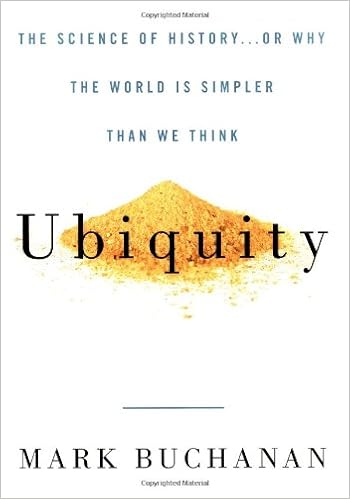
Ubiquity: The Science of History . . . or Why the World Is Simpler Than We Think, by Mark Buchanan

Ebook Free Ubiquity: The Science of History . . . or Why the World Is Simpler Than We Think, by Mark Buchanan
Do not make you feel hard when looking for publication that you will certainly check out to save your time. Book is always popular in every single time, every age, and every age. All people will need book as recommendation to do something. When you have no ideas concerning exactly what to do in this spare time, obtain Ubiquity: The Science Of History . . . Or Why The World Is Simpler Than We Think, By Mark Buchanan as one of the reference books that we give! Supplying unique books are so positive for us. It is so very easy to give kindness for everybody.
However, it will depend upon just how you take the book. As currently, we will certainly reveal you a book named Ubiquity: The Science Of History . . . Or Why The World Is Simpler Than We Think, By Mark Buchanan It can be your analysis material to enjoy currently. When obtaining guide as just what you wish to check out, you can obtain just what choose from this book. It is the means to conquer the visibility of producing guide to check out. This book is not just the book that you could require in this time. Be sure that sometimes, you will require Ubiquity: The Science Of History . . . Or Why The World Is Simpler Than We Think, By Mark Buchanan as one of the advice.
Checking out will not make you constantly imaging and also dreaming about something. It must be the fashion that will certainly get you to really feel so wise and also wise to undergo this life. Also analysis might be boring, it will certainly depend on guide type. You can select Ubiquity: The Science Of History . . . Or Why The World Is Simpler Than We Think, By Mark Buchanan that will certainly not make you really feel bored. Yeah, this is not kin of entertaining publication or spoof book. This is a publication where each word will certainly offer you deep definition, but very easy and straightforward said.
When getting Ubiquity: The Science Of History . . . Or Why The World Is Simpler Than We Think, By Mark Buchanan as your reading resource, you may obtain the basic way to evoke or get it. It requires for you to choose and also download the soft documents of this referred publication from the link that we have actually provided here. When everybody has truly that great sensation to read this publication, she or the will constantly think that checking out book will certainly constantly guide them to obtain better location. Wherever the location is permanently much better, this is what probably you will certainly get when selecting this book as one of your reading sources in investing free times.
Amazon.com Review
Earthquakes, market crashes, hurricanes, wars: are these random forces of nature, or foreseeable blips on the radar screen of history? In this lively book, science journalist Mark Buchanan introduces readers to a developing branch of science that looks for order in what seems to be utmost chaos. In the late 1980s, three physicists set out to investigate the apparently inherent instability of complex systems. In a process that Buchanan illustrates by analogy with a sand pile, they discovered that these systems tend to arrive at a "critical state," after which point any random grain falling in just the right place can touch off an avalanche. So it is, Buchanan shows us, with the onset of world wars, economic shocks, traffic gridlock, and other dislocating events--all of which this new science may one day help predict. In clear and vigorous prose, Buchanan brings readers insights from nonequilibrium physics, offering a new way of seeing the "fingers of instability" that poke through the world's fabric--and that in turn make it such an interesting place. --Gregory McNamee
Read more
From Publishers Weekly
Buchanan, an editor and writer for Nature and New Scientist, proposes to apply so-called nonequilibrium physics to cataclysms in human history. This form of physics involves the study of systems in perpetual imbalance, a state that makes it possible for a small shock to trigger a disproportionately huge response. Buchanan thinks human beings are just such systems, and that the earth itself is another, and that their shared history earthquakes, eclipsed economies, extinctions, etc. reflects it. Particularly interesting is his chapter on revolutionary changes in intellectual ideas, in which he discusses a study quantifying "cataclysmic" shifts in thought by tracking citations in scientific papers. Buchanan allows how daunting a task it is to quantify history and acknowledges critics who say such an approach tempts oversimplification and overlooks the role of free will in human affairs. Buchanan notes, "It is at least a step toward greater understanding to recognize that the tumultuous course of humanity need not be the product of some deeply malignant human madness, but of ordinary human nature and simple mathematics," and thus finishes his book with questions rather than raw numbers. (On-sale: Oct. 23)Copyright 2001 Cahners Business Information, Inc.
Read more
See all Editorial Reviews
Product details
Hardcover: 288 pages
Publisher: Crown; 1 Amer ed edition (October 23, 2001)
Language: English
ISBN-10: 9780609608104
ISBN-13: 978-0609608104
ASIN: 060960810X
Product Dimensions:
6.5 x 1 x 9.8 inches
Shipping Weight: 1.2 pounds
Average Customer Review:
4.2 out of 5 stars
76 customer reviews
Amazon Best Sellers Rank:
#1,164,836 in Books (See Top 100 in Books)
A particularly interesting book which should be of interest to historians among others. The author, a physicist, demonstrates that events in a natural or historical environment move randomly into a critical state from which natural or historical catastrophes may or may not result. He applies mathematics to explain the randomness of the historical and natural world and shows how these same patterns apply to historical results in varied environments, but cannot be used to accurately predict the future.
In this book, titled ‘Ubiquity’, Mr. M. Buchanan, comes up with a new and fascinating discovery : There is a natural tendency toward instability “woven in the fabric of our world†which explains why catastrophes, both natural and human, happen. This tendency is ubiquitous and calls for a new science to better define it and demystify it. But, its footprints are everywhere in the spread of forest fires, earthquakes, stock market crashes, floods, and even in history and the rise and fall of nations.In this new 'science of ubiquity', as he calls it, the author believes that the whole world is modeled on a simple template. The basic concept is built around a pile of sand. Imagine trying to build up a pile of sand by dropping one particle at a time in the middle of the pile. Gradually, the pile will grow larger and higher into a conical shape with steep slopes. Ultimately, one reaches a stage, called the critical state, where adding on one more particle of sand creates an avalanche . That’s when the whole building process collapses. This, in the author’s theory, is how crises and catastrophes start. Of course, what happens at the critical stage, e.g. human interventions, will, where possible, define the course of subsequent events. For decades, if not centuries, scientists watched with horror the destruction in lives and properties caused by catastrophic eruptions whether in floods, earthquakes, fires, or even the stock markets. They watched in despair not knowing what to do. Some blamed these shocking events on God’s anger, or ignorance or mismanagement. But no one really had a clue. That is why this new discovery by Mr. Buchanan has been welcomed. At least, it shed some light on the nature of the problem .But there is much more to be done. In addition to verifying the the scope of this new science and its effectiveness we need to focus on the art of scientific predictions and preventions. Given that the above new science may be sound and acceptable, how do we employ it to prevent harm and destruction due to these natural catastrophes ?This reviewer lived through a major flooding disaster in the 1970’s in western NY state when a dyke broke and flooded the town. Although personally unharmed, the effect of the catastrophe left lasting, painful memories to this day. It became clear that the harm entailed by such events is not only physical (which could often be alleviated) but in fact psychological and mental. Watching friends and colleagues suffer physical and mental agonies was difficult to bear. Yet even after all these years, the cry for preventive measures is loud and clear - but mostly in vain.Fuad R QubeinDec. 2017
Great ideas, written with authority and showed the world is not predictable. But the book had no pertinent conclusion and got tantalizingly close to to some predictions at least . A power law, is it not one way of fitting data anyway, or perhaps that is the point of this difficult subject.My take home was that instabilities are out there in most natural systems and should be recognized as usual, though these can be managed if understood. Prediction of such systems relies on too many boundary conditions and should never be wrapped up in certainties.
Are there general rules in situations where scientists have so far failed to find predictable patterns (for instance, the timing of the next big earthquake, the form a snowflake might take, the next big move in the stock market, etc.)?The author explores examples of natural or social systems that are out of balance (in a “critical stateâ€) – as these systems are stressed, they are in a constant battle between stability and instability. For instance, dropping grains of sand on a sand pile creates a critical state. Over time, with every new piece of sand dropping on a sand pile, whatever happens next becomes unpredictable.In a critical state, the individual system parts may act in accordance to “simple†and predictable rules, but because there are so many parts and they may each interact and influence each other, the emerging behavior of the system as a whole becomes complex and unpredictable.When you look back in time, however, the system's behavior is not random and a pattern emerges: the power law - every time a certain defining feature (earthquake strength, % change in stock market) is double (or halved), the number of times such a feature occurred in history increases or decreases by a fixed factor.The power law produces scale invariant or self-similar systems: systems that look fundamentally the same at a bigger or smaller scale (think of fractals in computer land).Because the system looks the same at every level, there is no fundamental difference between a very large event or a very small event (a massive or small earthquake, a huge or small stock market move, a large or small slide in a sand dune).The key implications are that there is no such thing as a typical fluctuation (patterns of change are neither regular nor random), there is no reason to think that a very large swing is unusual or needs further explaining, and it is fundamentally impossible to predict the magnitude of the upcoming change.Because of this, any attempt to look for a singular cause to explain complex behavior is doomed to fail – there are no simple, deterministic laws for complex chains of events.The only thing that can be said about critical states is that under certain conditions, systems of interacting objects show universal features in their behavior (the power law). These ubiquitous properties arise again and again in things driven away from equilibrium and in things in which history matters.There are many critical states in nature (forest fires, earthquakes, snowflakes, gas phase transitions) and it is somewhat awesome to think that while unpredictable, there is a universal pattern that governs their behavior.The book becomes more speculative in the exploration of critical states in social settings, such as the stock market, spread of diseases, and more broad societal patterns (wars, city size and structure, evolution of scientific paradigms).I’m still trying to figure out the takeaways. At some level, if you can only understand these systems in hindsight through statistic analysis and if you can’t predict what happens next and specific individual causes don’t really matter, then so what? Still chewing on that.An interesting part of the book is that the science behind critical states takes the form of designing and running simulation games. Simulating natural or social critical states in (computer) games with (surprisingly) basic parameters produces statistical results that very closely match what is observed in real life. It will be interesting to see how these games will develop further.I would have perhaps liked the book to have a bit more structure, such as in terms of specific definitions of critical states and their components. Also, there are very clear links with topics such as entropy, network / information theory, biology / brain / intelligence, and emergent behavior and exploring those links in more detail would have been interesting as well.Having said all this, love reading about this stuff: exploring and trying to understand complex systems.
Ubiquity: The Science of History . . . or Why the World Is Simpler Than We Think, by Mark Buchanan PDF
Ubiquity: The Science of History . . . or Why the World Is Simpler Than We Think, by Mark Buchanan EPub
Ubiquity: The Science of History . . . or Why the World Is Simpler Than We Think, by Mark Buchanan Doc
Ubiquity: The Science of History . . . or Why the World Is Simpler Than We Think, by Mark Buchanan iBooks
Ubiquity: The Science of History . . . or Why the World Is Simpler Than We Think, by Mark Buchanan rtf
Ubiquity: The Science of History . . . or Why the World Is Simpler Than We Think, by Mark Buchanan Mobipocket
Ubiquity: The Science of History . . . or Why the World Is Simpler Than We Think, by Mark Buchanan Kindle



0 komentar